Approval Granted: Decommissioning and Dismantling of the Geesthacht Research Reactor Facility
Today, the Ministry for the Energy Transition, Climate Protection, Environment and Nature of the Federal State of Schleswig-Holstein officially handed over the license for the decommissioning and dismantling of the Geesthacht Research Reactor Facility to Helmholtz-Zentrum Hereon.
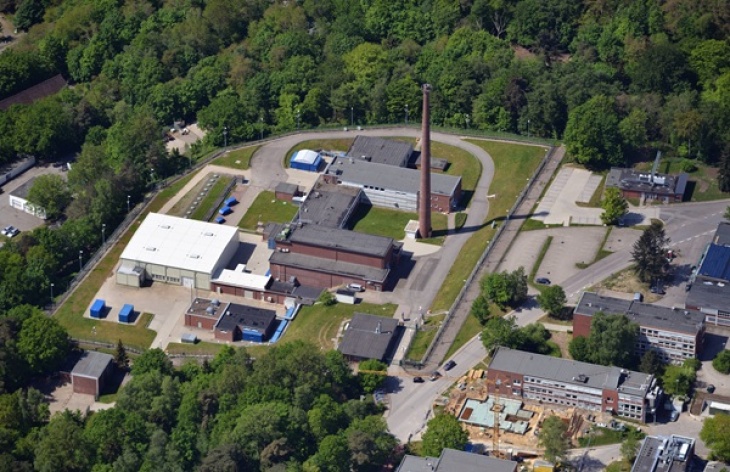
Aerial view of the Research Reactor Facility. Photo: Hereon/Burkhard Kuhn.
Initial preparatory measures had already been carried out during the post-operational phase: the site has been free of fuel elements since 2012, and the scientific experimental facilities have already been removed.
“Safety is our top priority throughout the entire decommissioning process. All dismantling activities will continue to be closely monitored by the nuclear regulatory authorities. Even after the decommissioning and dismantling license has been granted, many technical processes will require approval from the supervisory authority in Kiel,” explains Michael Iwainski Bremm, Head of the Research Reactor Facility at Hereon.
Decommissioning in Dialogue with the Region
“The planning and preparation for the decommissioning of the research reactor facility have been accompanied by an intensive dialogue with the people of the region for more than ten years. Together with local residents, environmental organizations, and representatives from politics and public administration, we discussed questions concerning decommissioning, radiation protection, and the planned activities. Some of the results from this FRG in Dialogue process were incorporated into the license application documents. We will continue this transparent exchange during the decommissioning phase that is now beginning,” says Prof Oliver Zielinski, Scientific Managing Director of Helmholtz-Zentrum Hereon.
The dismantling work is expected to take approximately 17 years and cost around 150 million Euros.
Background Information
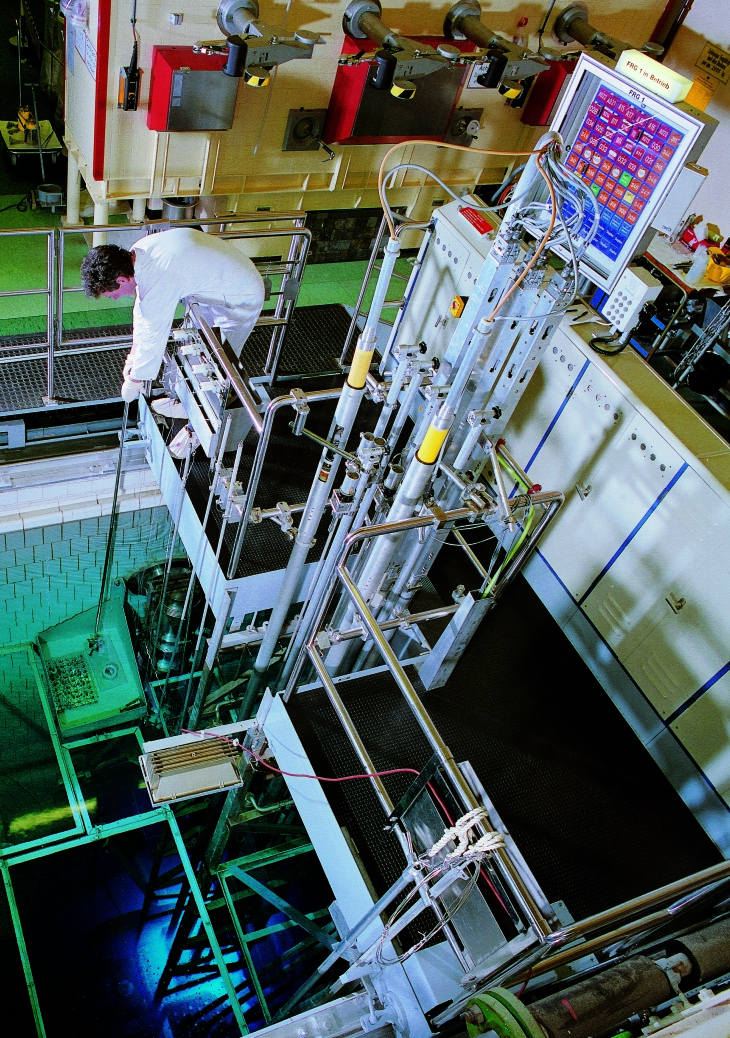
View from above into the reactor core (2005). Photo: Hereon.
Neutrons: “Super Microscopes” for Science
The Geesthacht Research Reactor Facility was built in 1956 and was continuously modernized throughout its operational life. Initially, it served research into the peaceful use of nuclear energy and played a central role in the 1960s in the development of the nuclear-powered research vessel OTTO HAHN. The ship was in service from 1968 to 1979 and was one of only a few civilian merchant vessels worldwide powered by a nuclear reactor.
The decommissioning and dismantling license also covers the reactor pressure vessel of the OTTO HAHN. The fuel-free vessel, which originated from the ship’s propulsion system, has been stored since 1981 in a specially designed shaft on the Hereon campus. As part of the decommissioning project, it will also be safely dismantled and disposed of in accordance with applicable regulations.
Following the OTTO HAHN project, the FRG-1 research reactor became an internationally recognized neutron source for materials research. Its neutron beams provided unique insights into the internal structure of materials and generated important findings for industry, aviation, energy technology, and medical engineering.
After more than 50 years of operation, the reactor was permanently shut down in 2010 as German neutron research was consolidated at a small number of large-scale research facilities. Since then, the German Engineering Materials Science Centre (GEMS) at Helmholtz-Zentrum Hereon has coordinated materials analysis through its own experimental stations at state-of-the-art neutron and synchrotron sources in Munich and Hamburg.
Cutting-edge research for a changing world
Helmholtz-Zentrum Hereon`s scientific research aims at preserving a world worth living in. To this end, around 1000 employees generate knowledge and research new technologies for greater resilience and sustainability - for the benefit of the climate, the coast and people. The path from idea to innovation leads through a continuous interplay between experimental studies, modeling and AI to digital twins that map the diverse parameters of climate and coast or human biology in the computer. This is an interdisciplinary approach that spans from the fundamental scientific understanding of complex systems to scenarios and practical applications. As an active member of national and international research networks and the Helmholtz Association, Hereon supports politics, business and society in shaping a sustainable future by transferring the expertise it has gained.